Search “Scotland flag” and you’ll get thousands of images — but very few clear answers. What do the colors actually mean? Why is it a diagonal cross instead of a straight one? And why does copying the Scotland flag emoji sometimes show a blank box instead of a flag? If you’ve ever needed the right answer fast — for a school project, a design brief, a trivia night, or just personal curiosity — this guide clears up the confusion in one place. Below, you’ll find the history, the official colors, the emoji code, and the small details most articles get wrong.
What Is the Scotland Flag Called?
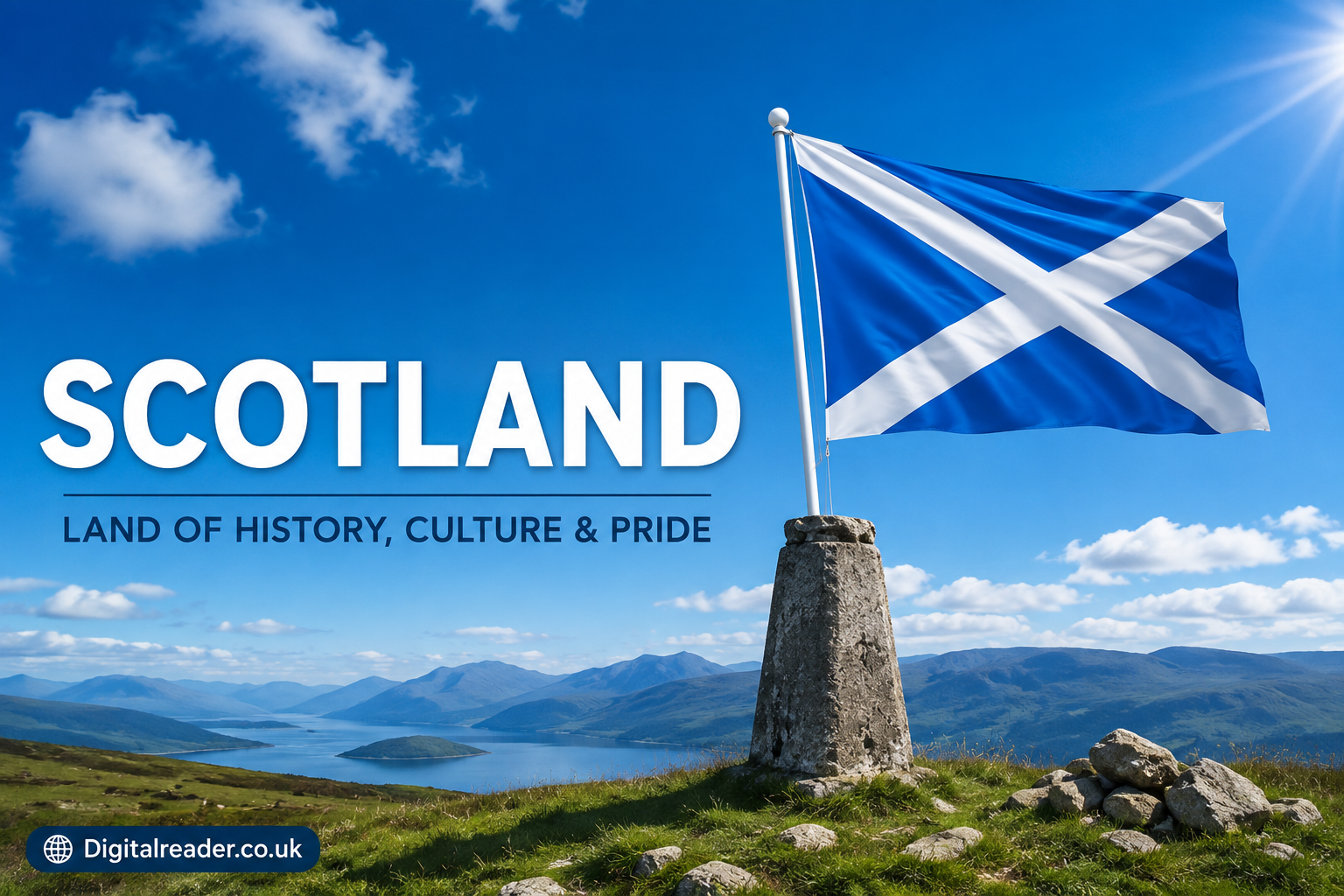
The Scotland flag is officially known as the Saltire, and it’s also called St Andrew’s Cross. It consists of a white diagonal cross on a blue background. In heraldic terms, it’s blazoned as “Azure, a saltire Argent” — Latin-derived language for “blue field, silver/white diagonal cross.” The Saltire is widely regarded as one of the oldest national flags still in use today, with some form of the design dating back centuries before most modern nations existed.
Scotland Flag Meaning: The Legend Behind the Saltire
The Battle of Athelstaneford Legend
The most famous origin story dates to 832 AD. According to tradition, King Óengus II led Picts and Scots into battle against an Angle army near what is now Athelstaneford, East Lothian. The night before the fight, Óengus is said to have prayed for victory, promising to make St Andrew the patron saint of Scotland if his forces won. The next morning, white clouds in the shape of a diagonal cross reportedly appeared against the blue sky — a formation the Scots took as a sign of St Andrew’s favor. They went on to win the battle, and the cross-in-the-sky became the symbol later adopted as the national flag. & more blogs to see fresh .
St Andrew and the Diagonal Cross
The diagonal shape isn’t arbitrary. St Andrew, one of Jesus’s apostles and Scotland’s patron saint, is traditionally believed to have been crucified on an X-shaped cross by his own request, feeling unworthy of dying on the same shape of cross as Jesus. That X-shaped “saltire” cross became his enduring symbol — and Scotland’s.
Scotland Flag Colors: Official Codes and Symbolism
Official Blue: Pantone 300
For most of its history, the exact shade of blue used on the Saltire varied widely, from deep navy to pale sky blue. That changed in 2003, when a committee of the Scottish Parliament formally reviewed the issue after a public petition. Taking advice from sources including the office of the Lord Lyon King of Arms, the committee recommended Pantone 300 as the optimum shade of blue for the flag.
In RGB terms, Pantone 300 translates to roughly 0, 101, 189, or #0065BD as a web hex color.This blue is noticeably brighter and lighter than the dark navy of the Union Flag, which helps the Saltire stand apart visually as a distinct national symbol rather than a subset of the UK flag.
What the Blue and White Represent
Traditionally, the blue and white of the Scottish flag are associated with meanings such as perseverance, loyalty, truth, justice, vigilance, honesty, and peace . The white cross is tied directly to the legendary clouds seen before the Battle of Athelstaneford, while the blue field represents the sky behind them.
Scotland Flag Color Codes Table
| Color | Pantone | Hex | RGB |
|---|---|---|---|
| Saltire Blue (official) | Pantone 300 | #0065BD | 0, 101, 189 |
| Saltire White | N/A | #FFFFFF | 255, 255, 255 |
Note: Because the flag has no single legally binding statute, you may still see older or unofficial versions using darker navy blue (closer to Pantone 280) or lighter azure tones. Pantone 300 is the version endorsed by the Scottish Parliament and most current manufacturers.
Scotland Flag Design and Proportions
The flag’s proportions aren’t fixed by law — common ratios include 1:2, 2:3, 3:5, and 4:5, with the diagonal bars of the cross generally set at one-fifth (20%) of the flag’s width. The 1:2 ratio has become the most common standard seen on flagpoles outside official buildings, while a 3:5 or 4:5 ratio is more typical for flags meant to be flown at a more square proportion.
Scotland Flag vs. Union Jack: What’s the Difference?
A common point of confusion is how the Saltire relates to the Union Jack. The short answer: the Union Jack is built partly from the Scottish flag.
| Feature | Scotland Flag (Saltire) | Union Jack |
|---|---|---|
| Design | White diagonal cross on blue | Combines England’s, Scotland’s, and Ireland’s crosses |
| Official blue | Pantone 300 (lighter) | Pantone 280 (darker navy) |
| Origin | 9th-century legend | Formed in 1606, updated 1801 |
| Represents | Scotland specifically | The United Kingdom as a whole |
Scotland Flag Emoji: How to Use It
Scotland Flag Emoji Code and Copy-Paste
Unlike most country flags, the Scotland flag emoji isn’t built from two letters — it uses a special tag sequence recognized by Unicode as a “subdivision flag.” You can copy it directly:
🏴
If you’re typing it manually in code, the Unicode sequence is: U+1F3F4 U+E0067 U+E0062 U+E0073 U+E0063 U+E0074 U+E007F On most modern iPhones, Android phones, and updated apps like WhatsApp, Twitter/X, and Slack, typing “Scotland flag” in the emoji search bar will bring it up automatically.
Why Some Devices Don’t Show It
If you see a plain black flag or a box with letters instead of the Saltire, it’s not a mistake on your part — it means your device, browser, or app hasn’t fully implemented Unicode’s regional subdivision flag support. Windows, in particular, has historically lagged behind mobile platforms here. Updating your OS or app usually resolves it.
Why This Matters
Getting flag details right isn’t just trivia. Brands, publishers, and designers regularly misuse national flags — wrong colors, wrong proportions, or confusing a country’s flag with a related but distinct symbol (like the Lion Rampant, which is Scotland’s royal banner, not its national flag). That’s a real mix-up worth avoiding, since the Lion Rampant is legally restricted to use by the monarch. For content creators, accuracy also matters for trust. A blog, product listing, or infographic using the wrong Saltire blue can look unprofessional to anyone familiar with Scottish culture or heraldry — a small detail that affects credibility.
Common Mistakes to Avoid When Using the Scotland Flag
- Using the Lion Rampant instead of the Saltire. The yellow-and-red Lion Rampant is a royal banner, not Scotland’s national flag, and its use is legally restricted.
- Using outdated navy blue. Pantone 280 (Union Jack blue) is commonly mistaken for the Saltire’s blue.
- Wrong cross width. A saltire that’s too thick or thin changes the flag’s proportions and visual balance.
- Assuming the emoji works everywhere. Older devices and some social platforms still can’t render it.
- Confusing “Scottish flag” search intent. Some searchers actually want the Union Jack or a tartan-pattern graphic — check context before publishing.
Expert Recommendations
- For designers: Use hex
#0065BDas your baseline blue, and confirm proportions (commonly 1:2) before printing physical flags. - For writers and marketers: Reference the Battle of Athelstaneford legend for engagement, but clarify it’s a legend, not verified historical fact, to maintain accuracy.
- For developers: Test the Scotland flag emoji across target platforms before relying on it in a UI, since rendering support still varies.
- For educators: Pair the flag’s story with St Andrew’s Day (November 30) for a natural, timely content or lesson-plan tie-in.
Scotland Flag: Pros and Cons of Common Design Variations
| Variation | Pros | Cons |
|---|---|---|
| Pantone 300 (official, lighter blue) | Modern, distinct from Union Jack, government-endorsed | Less common in older/vintage products |
| Darker navy (Pantone 280-style) | Traditional look, widely available | Can be confused with Union Jack blue |
| 1:2 ratio flag | Standard for flagpoles, widely manufactured | Looks less square/compact than 4:5 |
| 4:5 ratio flag | Matches the Scottish Flag Trust’s suggested Flag Code | Less commonly stocked commercially |
Conclusion
The Scotland flag is more than blue-and-white cloth — it’s a symbol built on centuries of legend, careful modern standardization, and genuine national identity. Whether you needed the official color code for a design project, the real story behind the Saltire, or simply the right emoji to copy and paste, you now have it all in one place.
FAQs
What does the Scotland flag look like?
The Scotland flag features a white diagonal cross (an X shape) on a blue background. It’s known as the Saltire or St Andrew’s Cross.
What is the meaning of the Scotland flag?
The flag is tied to a legend from 832 AD, in which cloud formations shaped like a white diagonal cross appeared against the sky before a battle, seen as a sign from St Andrew, Scotland’s patron saint.
What color blue is the Scotland flag?
The official recommended shade is Pantone 300, which is approximately #0065BD in hex and 0, 101, 189 in RGB. It’s a brighter blue than the Union Jack’s navy.
How do I get the Scotland flag emoji?
Search “Scotland” in your device’s emoji keyboard, or copy it directly: 🏴. It may not display correctly on outdated devices or apps.
Is the Scotland flag the same as the Union Jack?
No. The Scotland flag (Saltire) is Scotland’s national flag. The Union Jack combines elements of Scotland’s, England’s, and Ireland’s flags to represent the United Kingdom as a whole.
Why is the Scotland flag a diagonal cross and not a straight one?
The diagonal, or “saltire,” shape represents the X-shaped cross on which St Andrew is traditionally said to have been crucified, at his own request, out of humility.
Is the Lion Rampant the same as the Scotland flag?
No. The Lion Rampant is a royal banner (yellow and red) reserved for use by the monarch. The Saltire is the national flag used by the public.
In Short
- The Scotland flag is called the Saltire or St Andrew’s Cross: a white diagonal cross on a blue field.
- Its origin traces to a legend from 832 AD involving King Óengus II and cloud formations before a battle.
- The official blue is Pantone 300 (approx.
#0065BD), standardized by the Scottish Parliament in 2003. - The Scotland flag emoji (🏴) uses a special Unicode tag sequence and may not render on all devices.
- The Saltire is distinct from both the Union Jack and the Lion Rampant royal banner.