introduction of famous women in history
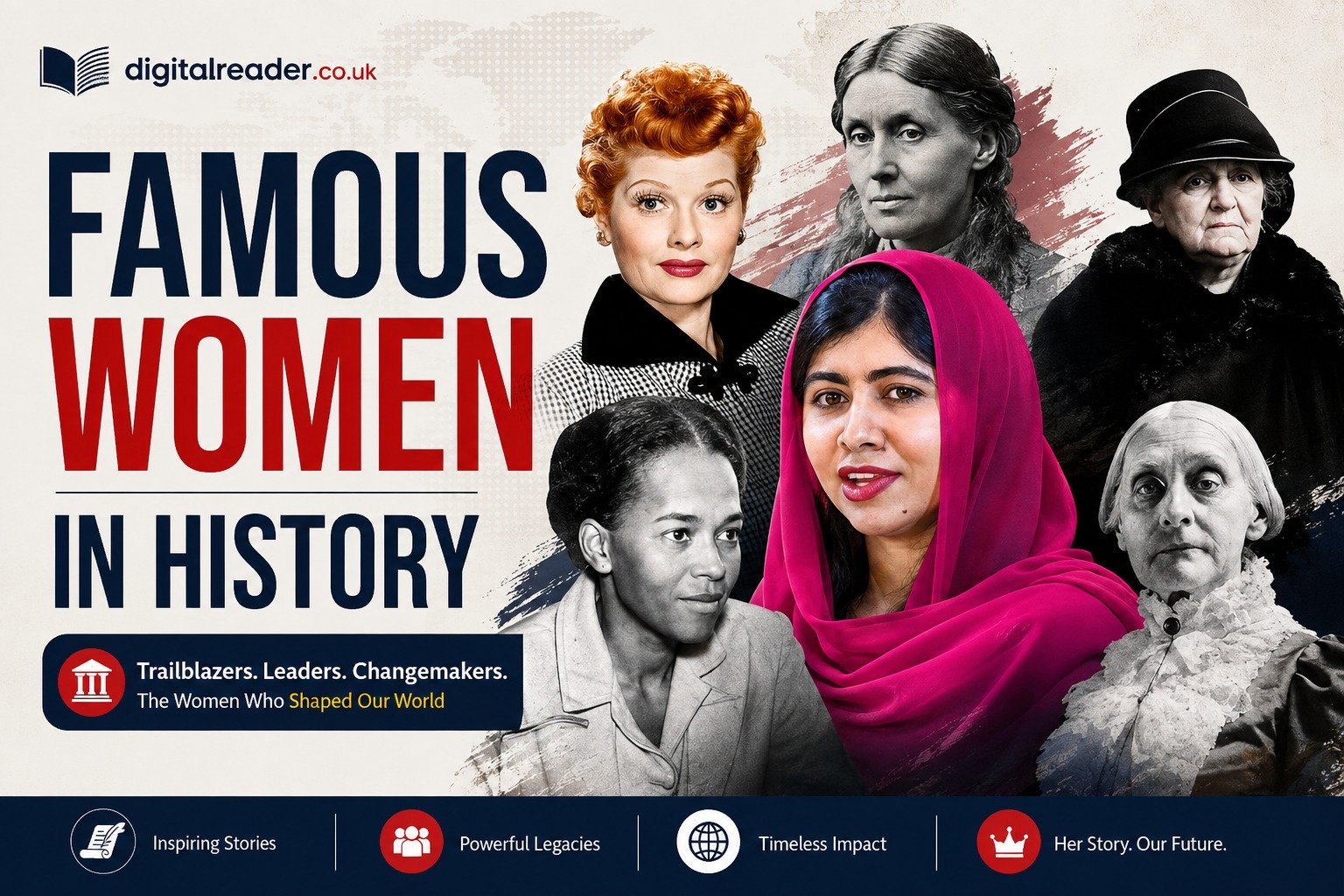
Who are the most famous women in history, and what made their lives so important? The answer is much bigger than a list of celebrities or famous historical figures. Women have influenced politics, science, civil rights, medicine, literature, aviation, business, art, and education—often while facing legal, social, racial, or economic barriers.For students, parents, teachers, and anyone searching for famous women in history names, choosing where to begin can be difficult. There are hundreds of remarkable stories worth knowing.This guide highlights some of the most influential women in history and explains why their achievements still matter today. It also includes a special section on black famous women in history and an easy-to-understand guide to famous women in history for kids.The National Women’s History Museum notes that women’s contributions have frequently been overlooked in mainstream historical narratives, which is one reason dedicated women’s history resources remain important.
Who Are the Most Famous Women in History?
There is no universally accepted ranking of the “most famous” women in history. Fame can mean different things: worldwide recognition, historical influence, groundbreaking achievements, cultural impact, or the ability to inspire future generations.A Smithsonian Libraries and Archives record for a major reference work on influential women includes figures such as Eleanor Roosevelt, Marie Curie, Harriet Tubman, Rosa Parks, Jane Austen, Florence Nightingale, Amelia Earhart, Frida Kahlo, Cleopatra, Lucille Ball, and many others.That diversity is important. A woman does not need to be a political leader to change history.
30 Famous Women in History Names to Know
| Woman | Known For | Historical Impact |
|---|---|---|
| Cleopatra | Egyptian ruler | Diplomacy and leadership |
| Joan of Arc | French military figure | Symbol of courage and national identity |
| Queen Elizabeth I | English monarch | Political leadership and cultural development |
| Jane Austen | Author | Influential English literature |
| Mary Wollstonecraft | Writer and philosopher | Early women’s rights advocacy |
| Florence Nightingale | Nursing pioneer | Modern nursing and healthcare reform |
| Harriet Tubman | Abolitionist | Freedom and anti-slavery activism |
| Sojourner Truth | Activist and speaker | Abolition and women’s rights |
| Susan B. Anthony | Suffrage leader | Women’s voting rights |
| Elizabeth Cady Stanton | Suffrage activist | Women’s rights movement |
| Marie Curie | Scientist | Pioneering research in radioactivity |
| Helen Keller | Author and advocate | Disability rights and education |
| Amelia Earhart | Aviator | Aviation pioneer |
| Rosa Parks | Civil rights activist | Montgomery Bus Boycott |
| Eleanor Roosevelt | Diplomat and activist | Human rights and public service |
| Frida Kahlo | Artist | Modern art and cultural identity |
| Maya Angelou | Writer and poet | Literature and civil rights |
| Katherine Johnson | Mathematician | Space exploration |
| Rachel Carson | Marine biologist and author | Environmental movement |
| Rosa Parks | Civil rights activist | Racial justice and civil rights |
| Shirley Chisholm | Politician | Representation in American politics |
| Ruth Bader Ginsburg | Supreme Court justice | Gender equality and law |
| Jane Goodall | Primatologist | Animal behavior and conservation |
| Billie Jean King | Athlete and activist | Women’s sports equality |
| Lucille Ball | Actor and producer | Television and entertainment |
| Georgia O’Keeffe | Artist | American modernism |
| Ida B. Wells | Journalist and activist | Anti-lynching activism |
| Mary McLeod Bethune | Educator and activist | Education and civil rights |
| Bessie Coleman | Aviator | Aviation opportunities for Black Americans |
| Mother Teresa | Humanitarian | Charity and humanitarian work |
Leaders and Political Figures
Women such as Cleopatra, Queen Elizabeth I, Eleanor Roosevelt, Shirley Chisholm, and Ruth Bader Ginsburg demonstrate that historical leadership takes many forms.Eleanor Roosevelt, for example, became internationally recognized for her work in public service and human rights. Shirley Chisholm broke major political barriers as the first Black woman elected to the U.S. Congress and later became the first Black candidate to seek a major-party nomination for president.These stories show that political influence is not limited to presidents and monarchs.
Scientists and Innovators
Some of the most important famous women in history names belong to science.Marie Curie transformed scientific understanding through her pioneering research into radioactivity and became one of the best-known scientists of the modern era.Katherine Johnson made important contributions to American spaceflight through her mathematical work at NASA.Jane Goodall transformed how many people understand chimpanzee behavior and helped popularize wildlife conservation.These women are particularly useful examples for students because their stories connect history with science, technology, mathematics, and innovation.
Activists and Civil Rights Pioneers
Women’s history cannot be separated from movements for equality and civil rights.Susan B. Anthony and Elizabeth Cady Stanton became major figures in the American women’s suffrage movement. Rosa Parks became an enduring symbol of the Civil Rights Movement after refusing to surrender her seat on a segregated Montgomery bus. The National Women’s History Museum describes her action as helping set in motion the Montgomery Bus Boycott.However, it is important not to reduce these women to a single famous event. Their wider lives, organizations, communities, and political work provide the historical context behind their achievements.
Black Famous Women in History
The story of black famous women in history is essential to understanding American history.The Smithsonian has documented the contributions of African American women across fields including science, mathematics, medicine, civil rights, education, law, journalism, business, art, music, sports, and government.
Harriet Tubman
Harriet Tubman escaped slavery and subsequently became one of America’s best-known abolitionists. She is remembered for her work helping enslaved people reach freedom through the Underground Railroad.Her story represents courage, resistance, leadership, and sacrifice. Smithsonian resources also emphasize the importance of understanding Tubman as a complete person rather than simply as an icon.
Rosa Parks
Rosa Parks is one of the most recognizable names in American civil rights history.Her refusal to give up her seat in Montgomery became a catalyst for the Montgomery Bus Boycott. Her story is particularly valuable for young learners because it illustrates how an individual action can become connected to a much larger social movement.
Sojourner Truth
Sojourner Truth was an abolitionist and women’s rights advocate whose speeches and activism challenged racial and gender inequality.Her legacy demonstrates how different social justice movements can overlap.
Ida B. Wells
Ida B. Wells was a journalist, investigator, and activist who challenged racial violence and discrimination.Her career is an excellent example of how journalism can become a tool for social reform.
Mary McLeod Bethune
Mary McLeod Bethune combined education, civil rights activism, organizational leadership, and political influence.
She founded the National Council of Negro Women and served as an adviser within President Franklin D. Roosevelt’s administration. The National Women’s History Museum highlights her extensive work in education and opportunities for Black youth.
Famous Women in History for Kids
Learning about famous women in history for kids does not need to feel like memorizing a long list of dates.
A better approach is to connect each person to one memorable achievement.
For example:
- Marie Curie: “She was a scientist who changed our understanding of radioactivity.”
- Amelia Earhart: “She helped break barriers for women in aviation.”
- Harriet Tubman: “She risked her life helping enslaved people reach freedom.”
- Rosa Parks: “Her protest became part of a major civil rights movement.”
- Katherine Johnson: “Her mathematics helped support American space missions.”
- Jane Goodall: “Her research changed how people understood chimpanzees.”
- Helen Keller: “She became an author and advocate despite being deaf and blind.”
A Simple Three-Step Learning Method
Step 1: Pick one woman.
Start with someone connected to the child’s interests.
Step 2: Learn one challenge and one achievement.
This makes the story easier to remember.
Step 3: Connect her story to today.
Ask what changed because of her work and whether the issue still matters.
The National Women’s History Museum provides biographies and educational resources specifically for students and educators, making it a useful starting point for further research.
Why This Matters
Women’s history is not simply an additional category of history. It helps create a more complete picture of how societies developed.The National Women’s History Museum was founded in 1996 specifically to make women’s contributions to American history more visible and recognized. The organization says its educational work is designed to address major omissions in traditional historical narratives.The Smithsonian American Women’s History Museum similarly describes its mission as expanding the story of America through often-untold accounts of women’s accomplishments.For students, this broader perspective can make history more representative. For adults, it can reveal how many familiar historical events involved women whose contributions were once overlooked.
Comparing Famous Women in History
| Area | Examples | What They Changed |
| Science | Marie Curie, Katherine Johnson | Scientific and technological progress |
| Civil Rights | Rosa Parks, Ida B. Wells | Racial equality and justice |
| Abolition | Harriet Tubman, Sojourner Truth | Opposition to slavery |
| Politics | Eleanor Roosevelt, Shirley Chisholm | Representation and public leadership |
| Literature | Jane Austen, Maya Angelou | Literature and cultural thought |
| Aviation | Amelia Earhart, Bessie Coleman | Opportunities in flight |
| Art | Frida Kahlo, Georgia O’Keeffe | Modern art and cultural expression |
| Medicine | Florence Nightingale | Healthcare and nursing |
| Environment | Rachel Carson, Jane Goodall | Conservation and environmental awareness |
| Sports | Billie Jean King | Equality in athletics |
Pros and Cons of Learning Through Famous Names
Pros
- Makes history easier to remember.
- Gives students recognizable starting points.
- Creates connections between different historical periods.
- Helps reveal overlooked contributions.
- Provides positive examples of leadership and resilience.
Cons
- Focusing only on famous individuals can oversimplify history.
- Some important community movements receive less attention.
- A person’s historical reputation may hide complexity.
- “Famous” does not always mean “most influential.”
The best approach is therefore to use famous individuals as entry points and then explore the movements, communities, institutions, and historical conditions around them.
Expert Recommendations
When researching most famous women in history, prioritize authoritative sources over random biography websites.
Look for:
- Museum and university resources.
- Primary historical documents.
- Library and archive collections.
- Reputable biographies.
- Sources that acknowledge historical context and uncertainty.
Avoid treating one famous quote, photograph, or viral social-media claim as proof of an entire historical story.
A particularly strong research strategy is to compare at least two authoritative sources before publishing a biographical claim.
Common Mistakes to Avoid
1. Treating fame as the same as importance
A person can be famous without being the most historically influential.
2. Reducing women to one achievement
Rosa Parks, Harriet Tubman, and other historical figures had much more complex lives than their most famous moments suggest.
3. Ignoring historical context
Understanding laws, social conditions, racism, sexism, economics, and political institutions often explains why an achievement was so significant.
4. Using unsupported statistics
If a number cannot be verified through a reliable source, leave it out.
5. Presenting disputed facts as certain
Historical biographies sometimes contain conflicting accounts. High-quality content should distinguish established facts from interpretation.
FAQs
Who is the most famous woman in history?
There is no universally accepted answer. Figures such as Cleopatra, Marie Curie, Joan of Arc, Queen Elizabeth I, Harriet Tubman, Rosa Parks, and others are frequently recognized for exceptional historical influence.
Who are five famous women in history?
Five widely recognized examples are Marie Curie, Harriet Tubman, Rosa Parks, Amelia Earhart, and Eleanor Roosevelt. The best choices depend on whether the focus is science, civil rights, aviation, politics, or another field.
What are some famous women in history names?
Popular historical names include Cleopatra, Joan of Arc, Jane Austen, Florence Nightingale, Harriet Tubman, Susan B. Anthony, Marie Curie, Rosa Parks, Amelia Earhart, Frida Kahlo, and Eleanor Roosevelt.
Who are famous women in history for kids?
Good starting points include Harriet Tubman, Marie Curie, Amelia Earhart, Rosa Parks, Katherine Johnson, Jane Goodall, Helen Keller, and Florence Nightingale because their stories connect clearly to courage, science, education, exploration, and social change.
Conclusion
The most famous women in history were not all leaders in the traditional sense. Some changed science, others challenged injustice, created art, transformed literature, expanded political representation, or opened doors in fields where women had been excluded.Names such as Marie Curie, Harriet Tubman, Rosa Parks, Amelia Earhart, Jane Goodall, Eleanor Roosevelt, Katherine Johnson, and many others remain powerful because their achievements continue to influence the world.For children and adults alike, the best way to study these women is not simply to memorize their names. Ask what problem they faced, what they accomplished, who helped them, what obstacles they encountered, and how their work changed what became possible afterward.
Back to home